
Are you ready to discover the fascinating world of Japanese short stories? Reading in a foreign language is one of the most effective ways to improve but doing it for an extended period can also be exhausting, especially when you need to grasp new grammar and vocabulary at the same time. Short stories offer a perfect compromise. With their selfcontained plots and concise length they will sharpen your Japanese without overwhelming you. And being able to finish a story aimed at native speakers in one afternoon can also feel like a great accomplishment.
What I personally really like about short stories is that they also allow you to explore different genres and styles in Japanese literature. I think this makes them a great introduction to more literary works such as novels and classic literature as well. If transitioning directly from graded readers or children’s books to complex literature seems daunting at the moment, I can really recommend reading some Japanese short stories to build up your understanding of literary Japanese expressions and text flow.
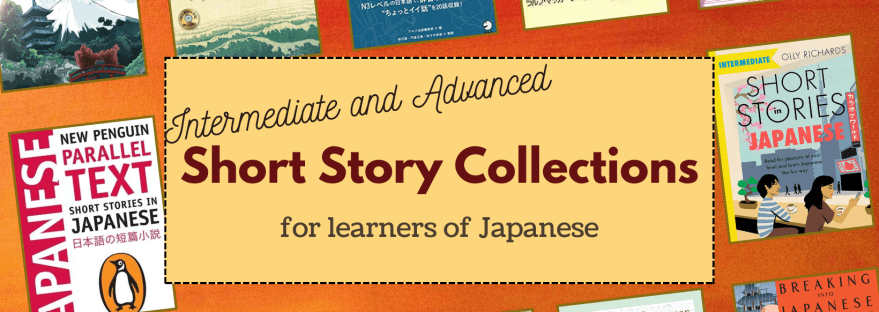
In this blog post, we’ll explore three approaches for intermediate and advanced learners to enjoy Japanese short stories. For each I can also recommend a few matching short story collections:
- Short Stories in Easy Japanese
- 日本語ショートストリーズどんどん読める
- Lingo Mastery Short Stories
- Olly Richards: Intermediate Short Stories in Japanese
- Japanese Short Stories with English Annotations
- Annotated Japanese Literary Gems
- Parallel Readers
- New Penguin Parallel Text: Short Stories in Japanese
- Breaking Into Japanese Literature & Exploring Japanese Literature
- One Upon A Time in Japan
- …and more!
Short Stories in Easy Japanese
The short story collections in this category are designed as graded readers, which means they feature stories with a limited usage of grammar and vocabulary. This approach makes them particularly suitable for learners who are still building their language skills. These short stories can either be original stories that were specifically written for language learners or easy adaptations of existing short stories.
With their beginner-friendly stories and helpful aids such as glossaries and comprehension questions, the following collections are a great way to start reading in Japanese and build your confidence in reading comprehension.
日本語ショートストリーズどんどん読める

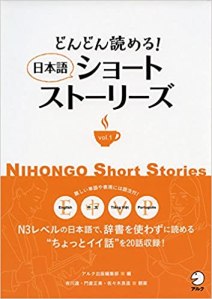
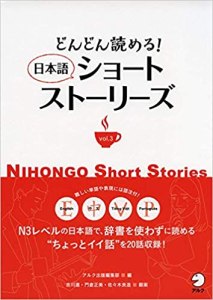
If you’re an intermediate learner aiming for JLPT N3, you might want to check out the short story collections released by textbook publisher アルク in 2017 and 2018. These collections feature three books, each with about 140 pages and 20 short stories, each ranging from 3 to 5 pages in length.
One great feature of these collections is that each short story is accompanied by an illustration and a couple of opening sentences, which help readers understand the context and get a feel for the story. In addition, every kanji is accompanied by furigana, making it easier to read, and there are annotations for vocabulary above N3 and idioms.

Lingo Mastery Short Stories
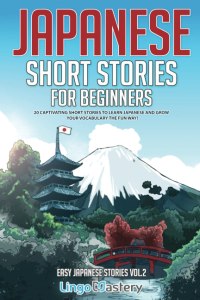
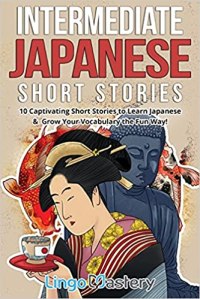
If you’re looking for short story collections that offer even more additional explanations and learning aids, Lingo Mastery’s collections are worth checking out. They offer both beginner and intermediate collections and were published in 2020 and 2021 featuring 20 short stories each in both beginner books and 10 short stories for the intermediate book.
What sets these collections apart is the inclusion of translations into English, summaries, vocabulary lists, and comprehension quizzes after every story. With these additional aids, learners can deepen their understanding of the stories and expand their vocabulary and grammar knowledge. In total, each story comes with about 8 pages of additional explanations, making these collections a great choice for learners who want to try translating to English what they are reading in Japanese.

Olly Richards: Intermediate Short Stories in Japanese
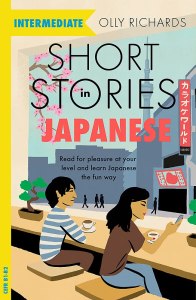
If you’re looking for a more immersive short story collection for Japanese learners, you might want to check out Olly Richards’ latest book, published in 2022. This collection features 8 different stories, each divided into chapters, e.g. the first story about two exchange students from London, 「クレイジーすし屋(や)」actually consists of 4 chapters.
After every chapter, the book offers a summary in Japanese, a vocabulary list, and reading comprehension quizzes, which can help readers deepen their understanding of the story. With its focus on immersion, the book does not offer translations into English.
I personally found Olly Richards’ stories engaging for learners at an intermediate level, although some plot points may feel a bit abrupt. If you’re looking for an immersive reading experience of short stories that will keep you motivated to read more, this book is a great choice though.
Japanese Short Stories with English Annotations
If you’re interested in exploring more classic literary works in their original form, Japanese short story collections with English annotations can be a great way to dive deep into the Japanese language and appreciate how renowned writers built their stories in the original. Many short story authors that are still popular today were at their peak during the last century and tend to use more complex language, including outdated Japanese grammar, flowery language, and complex kanji.
While reading these classic works in their original form can be challenging, it can also be highly rewarding. Making use of short story collections with English annotations can really help aspiring advanced learners to understand more complex sentence structures, idiomatic expressions, and unfamiliar vocabulary in these older and more literary short stories.
Annotated Japanese Literary Gems
These two volumes of short stories were collected and annotated by Kyoko Selden and Jolisa Gracewood. So far they are the only short story collections published with English annotations, but thus available in many public or college libraries for those studying modern Japanese literature.
Their helpful annotations in English explain the use of specific kanji, older grammar points and also include valuable insight into older idioms and cultural connotations that aren’t obvious to modern readers.


Parallel Readers
There’s a surprising amount of short story collections that are published as parallel readers! A parallel reader includes both the Japanese original and the English translation on a double page spread, so that you can easily check a sentence’s meaning just by glancing at the translation.
A lot of these also feature annotations in addition to the translations. This makes them great to study the original Japanese with but you may also enjoy the impressive work of the translators.
New Penguin Parallel Text: Short Stories in Japanese

This short story collection was published in 2011 and features short stories by Murakami Haruki, Yoshimoto Banana and other contemporary Japanese authors as well as the translations of their short stories by Michael Emmerich.
You’ll get furigana on every kanji when it first occurs in a story and there are also annotations on word use and grammar in the back. I personally would have liked if some core words could have been highlighted as it was often hard to find the translation of the specific line I was at.
Breaking Into Japanese Literature & Exploring Japanese Literature
These are two books by Giles Murray that let you read short stories by famous authors Natsume Sōseki and Akutagawa Ryūnosuke and more as well as their translations. Compared to the stort story collection by Penguin above, these stories are a bit older and therefore use more classical Japanese in their vocabulary and grammar.
Both books have furigana on all kanji and annotations at the bottom of the page that provide you with additional translations of particular words. The pages can thus look a bit crowded, but the beautifully illustrated title pages for each story do make up for that.


One Upon A Time in Japan
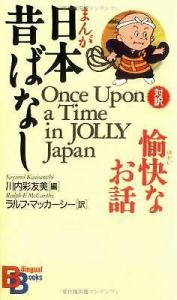
The short story collections by the publisher bilingual books features Japanese folklore and fairy tales with cartoonish illustrations on every other page. The translations opposite the Japanese read like they were intended for readers who did not know Japanese and sometimes felt a bit disconnected from the original, when e.g. the text continues in one language on the next page but not in the other.
I’ve read the short story collection Once upon a time in Jolly Japan, which was a collection of folk tales such as the farting bride and Ikkyu-kun, which were a bit crass here and there but still entertaining.

…and more!
I unfortunately wasn’t able to have an in-depth look at these books, but still wanted to mention them: Reading Japanese with a Smile is a parallel reader by Tom Gally that also includes annotations on vacabulary or cultural connotations. And both Japanese Stories for Language Learners and Japanese Folktales for Language Learners are parallel readers by Eriko Sato and Anne McNulty/Anne Sato. The exerpts I’ve read looked well structured in both Japanese and English and featured cute illustrations as well.


Notes on Difficulty
Whether you are just starting to read more in Japanese or are already interested in exploring contemporary or modern classic Japanese literature, there will be a short story collection just for your needs! All the books introduced here are intended either for language learning or bilingual text analysis and work best in my opinion for intermediate up to advanced learners (with the exception of the two beginner graded reader collections).
Of course, once you’ve reached the advanced levels you’ll also find an abundance of short story collections if you start looking for books published for native speakers of Japanese. I recently got my hands on a book with Japanese classics written in kobun/bungo and it had annotations and a translation into modern Japanese for every story. So really, there’s no upper limit when it comes to learning Japanese from short story collections.
Have fun reading your Japanese short stories!

 dokushoclub.com