
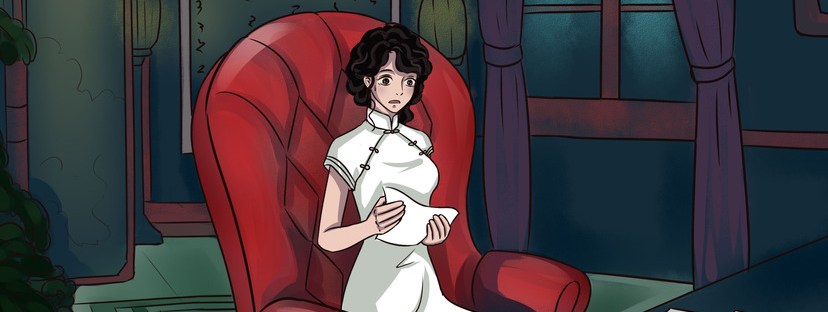
Don’t be fooled by the English title – this too is a story in Japanese: A retelling of Edogawa Ranpo’s 「人間椅子」in simple Japanese, providing several methods of support for first-time readers.
Titel: The Human Chair
Original Author: 江戸川乱歩(えどがわらんぽ)
Adapted by: yomu yomu © Sinamon AB
Length: 8 chapters à ca. 800 characters
Link: https://yomuyomu.app/lessons/courses/2-the-human-chair
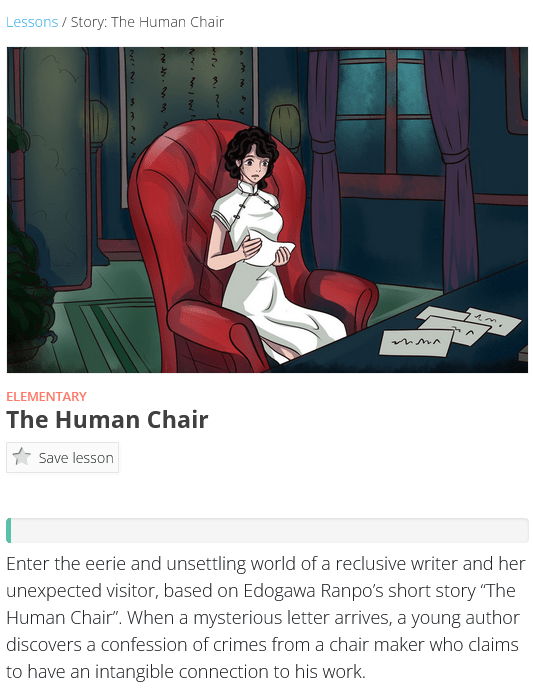
In The Human Chair the author Yōko1 receives a letter that looks like a manuscript at first but addresses her to apologize for what was done to her. Although she is unsure what this might refer to and the sender of the letter remains unnamed, she continues to read on.
Edogawa Ranpo’s original story is from 1925 and therefore public domain but requires experience with reading older Japanese, so rewriting it in simple Japanese makes it accessible for learners who are interested in reading this story at an early level.
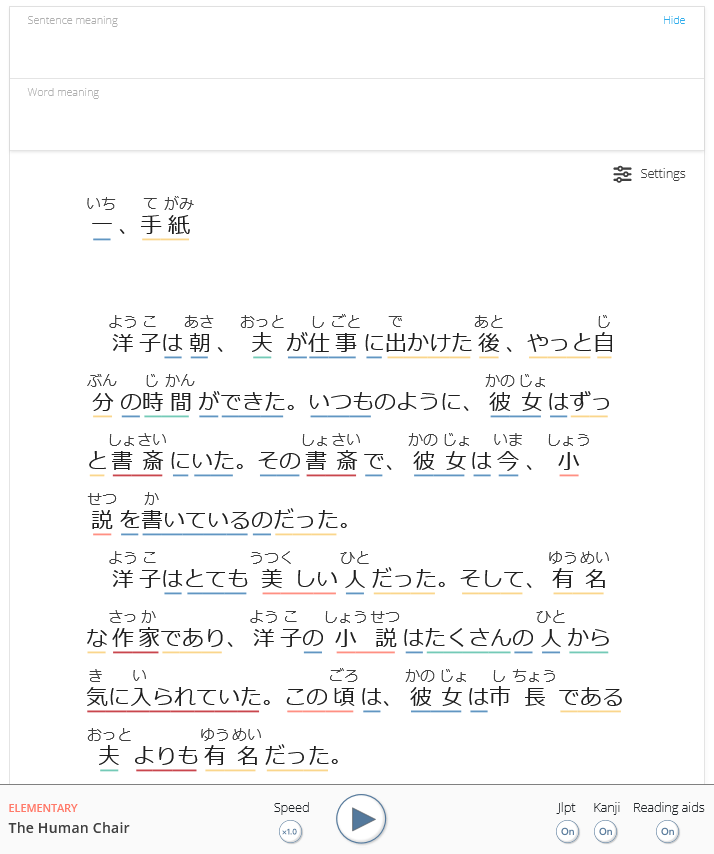
On the bottom you have several options to adjust the amount of help you will get in the form of reading aids. You can have the text read for you and can adjust the speed. You can toggle on rōmaji and furigana. And by default, all words are underlined in color to indicate the JLPT level:
Blue, green and yellow each indicate N5 (Beginner I, Beginner II and Beginner III by their own system), then salmon for N4, red for N3, purple for N2 and black for N1. (I personally turned the colors off because knowing the JLPT level of the vocabulary did not benefit me much, but I can see how this information could be useful to other learners.)
More importantly, if you hover over a word, you will receive further information on the top of the text: the reading, a translation into English, pitch accent and JLPT level. And if you click, you will also receive a translation of the full sentence in the row above.

The first three chapters are free, after that you will need a premium subscription to continue with chapters 5-8.
https://yomuyomu.app/lessons/courses/2-the-human-chair
- The name of the author is usually written 佳子 and transcribed as ‘Yoshiko’ in other adaptations of this story, but in this version they have chosen the name 洋子 with the reading Yōko. ↩︎

 dokushoclub.com